USD
  • EUR
  • INR
  • USD
Cart
Cart 0
  • You have no items in your shopping cart.
    Bagisto Laravel Extensions
    Cart
    Cart 0
    • You have no items in your shopping cart.
    Hire a Developer
    ×
    Contact Us!
    Send Again
    Close
    Please Login to Write Your Review
    Bagisto Shopify Connector

    Bagisto Shopify Connector

    x
    Free
    $99.00
    Add To Cart

    Bagisto Shopify Connector links Shopify stores with Bagisto. Admins and sellers import products and sync inventory both ways from their own panel.


    • Run Shopify product sync into Bagisto from a live product grid.

    • Create simple, virtual, or configurable products based on each variant.

    • Sync stock both ways between Bagisto and mapped Shopify locations.

    • Let marketplace sellers connect their own Shopify stores.

    • Map Shopify fields to Bagisto attributes with a ready default mapping.

    • Map categories, variant options, and inventory sources per store.

    • Refresh previously imported products without creating duplicates.

    • Verify every Shopify webhook with an HMAC-SHA256 signature check.

    Bagisto Shopify Connector
    Bagisto Shopify Connector
    $99.00
    Check How It Works

    Need Help Deciding?

    Support answers within one business day.

    Open a ticket
    $99.00
    Configure and Buy
    X
    • Description
    • Reviews
    • FAQ
    • Customers ()
    • Specifications
    • Cloud Hosting
    • Changelog

    Bagisto Shopify Connector is a Bagisto extension that pulls products from Shopify stores and keeps inventory aligned in both directions.

    An admin or seller adds a store with its shop URL, client ID, and client secret. The connector reads it through the Shopify GraphQL Admin API.

    Products arrive as simple, virtual, or configurable items, and variant images come along with them.

    Field mapping, import chunk size, the daily import cap, and inventory sync are all set in configuration.

    The connector supports Bagisto v2.5.0 and needs the Marketplace package. It runs on MySQL or PostgreSQL.

    Additionally, if you want to run a multi-seller store on Bagisto, then check Laravel Multi Vendor Marketplace.
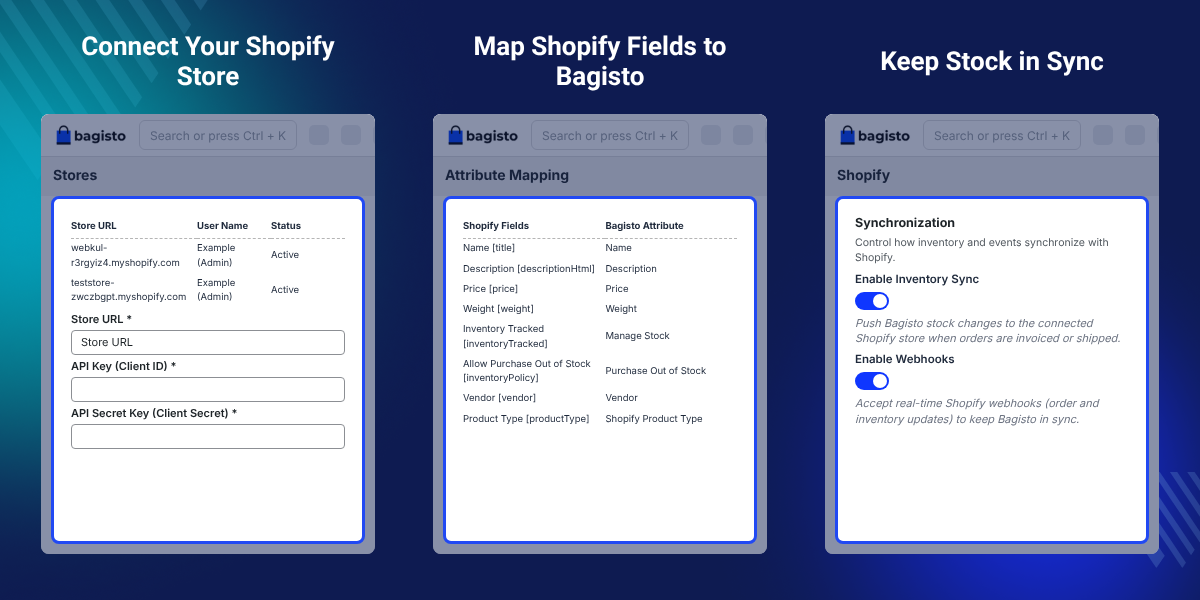
    Bagisto Shopify Connector

    Highlighted Features of Bagisto Shopify Connector

     Import Shopify Products

    Pick products from a live Shopify grid with filter and sort, then import them as queued jobs.

     Two-Way Inventory Sync

    Invoices and shipments reduce Shopify stock, and Shopify orders reduce Bagisto stock.

     Seller Store Connections

    Each seller links their own Shopify store, and no seller can open another seller's connection.

     Configurable Field Mapping

    Map title, price, weight, vendor, tags, SEO fields, and more to Bagisto attributes without code.

     Signed Webhooks

    Every webhook is checked against the connection's client secret before any data changes.

     Update Existing Products

    Re-pull imported products on demand. A stored link table keeps the same children and avoids duplicates.

    Why Do We Need Bagisto Shopify Connector?

    Bagisto Shopify Connector exists because Bagisto cannot read a Shopify catalogue by default. Sellers on Shopify must enter every product again. Manual entry takes time and breeds mistakes. Titles, prices, and images drift apart, and stock counts differ.

    A Bagisto Shopify integration removes that gap. The connector removes that work. Products arrive with the right type, and stock moves between both stores at the locations you map.

    Each variant keeps its own image, and a re-sync updates the same child products instead of adding new ones.

    Also, if you want to sync accounting data from Bagisto to QuickBooks, you can check Bagisto (Laravel) QuickBooks Connector.

    Bagisto Shopify Connector Use Cases

    • Move a Shopify Catalogue

      A store owner brings an existing Shopify catalogue into Bagisto without re-keying products.

    • Onboard Marketplace Sellers

      A marketplace owner lets sellers who run Shopify bring their own products into the seller panel.

    • Sell on Both Channels

      A seller lists the same stock on Shopify and Bagisto, and both counts stay in step.

    • Run Several Shopify Stores

      An admin links many stores, each with its own credentials and its own mappings.

    Shopify Connector Configuration in Bagisto

    Configuration controls how the connector behaves. Admins open it under Configure > Marketplace > Shopify.

    Settings are grouped as General, Synchronization, and Emails, so a store can tune limits and alerts in one place.
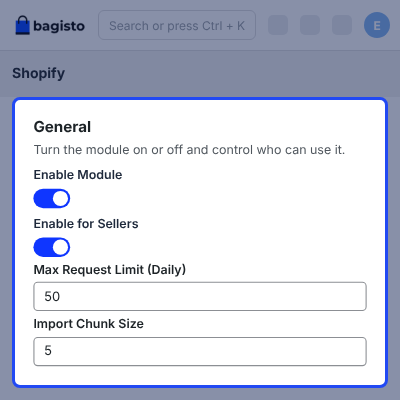
    • Switch Enable Module on, and switch Enable for Sellers on when sellers should connect stores.
    • Set the Max Request Limit (Daily), the daily import cap. The default is 50.
    • Set the Import Chunk Size, the products per queued job. The default is 5.
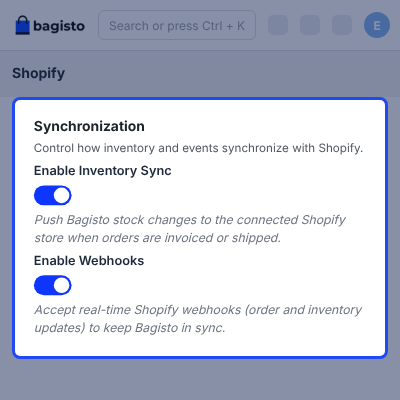
    • Switch Enable Inventory Sync on to push stock changes to Shopify.
    • Switch Enable Webhooks on to accept Shopify webhooks.
    • Turn the Import Success Email and Import Failure Email on or off.
    Shopify Connector Configuration in Bagisto

    Shopify Store Connections

    The Connections grid lists every linked Shopify store. Admins and sellers create, edit, and delete their own connections here.

    Each connection keeps its own credentials, so one store never sees another store's data.
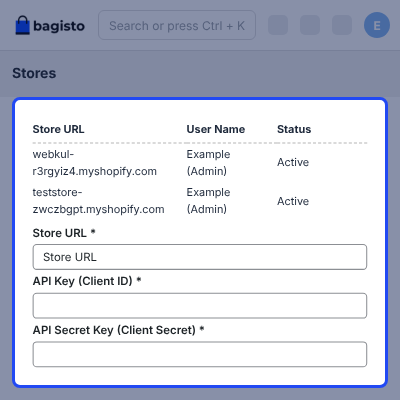
    • Enter the Store URL, API Key (Client ID), and API Secret Key (Client Secret) for each store.
    • Authenticate with the Client Credentials Grant, with no long-lived token stored.
    • Encrypt the client secret and access token at rest.
    • Grant the required access scopes: read_products, write_products, read_locales, read_publications, read_locations, and write_inventory.
    • Search, edit, or delete connections from the grid.
    Shopify Store Connections

    Shopify Attribute Mapping

    Attribute Mapping decides which Shopify field fills which Bagisto attribute. A global default mapping works from day one.

    A connection can override the default with its own mapping when a store needs different rules.
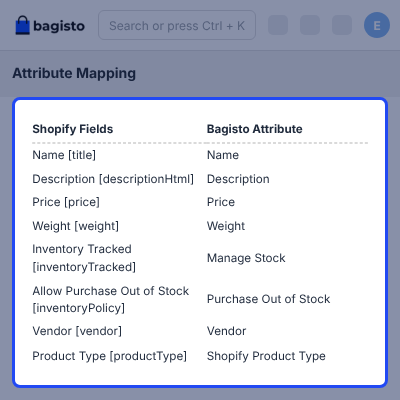
    • Map title, description, price, compare-at price, cost, and weight.
    • Map vendor, product type, tags, barcode, handle, and taxable.
    • Map inventory tracked, allow purchase when out of stock, SEO title, and SEO description.
    • Read a tooltip on each field that states which attribute types it accepts.
    • Use the default pairs, such as title to name and handle to URL key.
    Shopify Attribute Mapping

    Shopify Inventory Sync and Webhooks

    Inventory sync keeps stock equal in Bagisto and Shopify. Changes move only at the locations you mapped.

    Webhooks are registered when a connection is created, and each store has its own endpoints.
    • Reduce Shopify stock when Bagisto creates an invoice or shipment.
    • Reduce Bagisto stock on the orders/create webhook.
    • Pull current quantities on the inventory_levels/update webhook.
    • Reject unsigned or mismatched requests with a 401 before data is touched.
    • Switch inventory sync and webhooks on or off in configuration.
    Shopify Inventory Sync and Webhooks

    Seller Panel Shopify Connector

    When Enable for Sellers is on, each seller gets a Shopify entry in the seller panel.

    Sellers manage their own connections, mappings, and imports. They never see another seller's store.
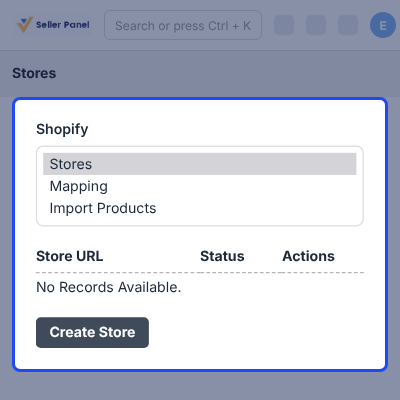
    • Create, edit, and delete store connections from the Stores page.
    • Set category and variant mapping from the Mapping page.
    • Import Shopify products from the Import Products page.
    • Receive a 404 when opening another seller's connection id.
    • Rely on separate seller permissions for connections, mapping, and imports.
    Seller Panel Shopify Connector

    Complete Bagisto Shopify Connector Feature List

    Product Import & Sync

    • Import Shopify products as simple, virtual, or configurable Bagisto products with simple children
    • Create a simple product when a variant needs shipping, and a virtual product when it does not
    • Fetch each variant's own image on import and on every re-sync
    • Update existing products with cursor pagination, and reset the imported flag to import again
    • Import in chunks as queued jobs, with a daily import cap per user

    Mapping & Configuration

    • Map Shopify fields to Bagisto attributes with a global default and per-connection overrides
    • Map categories, variant options, and inventory sources to Shopify locations for each store
    • Add the inventory policy, vendor, product type, tags, barcode, and taxable attributes on install
    • Set import chunk size, request limit, sync, webhook, and email options under Configure

    Inventory & Webhooks

    • Reduce Shopify stock on Bagisto invoices and shipments at mapped locations only
    • Reduce Bagisto stock from orders/create and pull quantities from inventory_levels/update
    • Register webhooks on connection create, with one route per connection id
    • Set a boolean is_on_marketplace metafield on Shopify when a product is imported or reset

    Marketplace & Roles

    • Enable the connector for the admin only, or for sellers as well
    • Give admin and sellers separate controllers, jobs, grids, menus, and ACL permissions
    • Isolate seller connections and return 404 for another seller's connection
    • Link many Shopify stores per admin and per seller

    Security & Credentials

    • Authenticate with the Client Credentials Grant and store no long-lived token
    • Encrypt the client secret and access token at rest
    • Verify every webhook with HMAC-SHA256 against the client secret
    • Validate required API scopes, including read_locations and write_inventory
    • Refresh tokens every 45 minutes and retry a 401 request once with a fresh token

    Reliability & Tools

    • Run heavy work on the dedicated shopify queue with a 60 second job timeout
    • Back off on 429 and THROTTLED responses, and refuse import when the queue is set to sync
    • Log to the shopify-connector channel and run shopify:connect, shopify:queue-work, and shopify:refresh-tokens
    • Add six tables of its own and leave every core table unchanged
    • Use Notifications and import emails, and ship in 22 languages

    Support

    For any query or issue, please create a support ticket here http://webkul.uvdesk.com/. You may also check our all Bagisto Extensions.

    Specifications

    Product Version2.5.0
    ReleasedToday
    CategoryBagisto Laravel, 
    Last UpdatedOctober 14, 2026 (Today)
    Supported VersionsBagisto  2.5.x  

    Ratings

    We'd love to hear your thoughts! Share your feedback and help us craft an even better experience tailored just for you.

    Write a review

    Frequently Asked Questions

     How does Bagisto Shopify Connector work?
    Bagisto Shopify Connector links a Shopify store through its shop URL, client ID, and client secret. Admins and sellers then import products and sync stock from the Bagisto panel.
     
     Which product types does it create?
    A variant that needs shipping becomes a simple product, and one that does not becomes a virtual product. Two or more physical variants with an option axis become a configurable product.
     
     Does the sync run both ways?
    Inventory syncs both ways. Product import runs from Shopify into Bagisto only.
     
     Can marketplace sellers connect their own Shopify stores?
    Yes. Enable the connector for sellers in configuration, and each seller links their own stores. A seller cannot open another seller's connection.
     
     What happens if I import the same product twice?
    The connector stores the link between Shopify and Bagisto products and variants. A re-sync updates the same products and children, so no duplicates appear.
     
     Is there a limit on how many products I can import?
    Yes. The Max request limit sets a daily import cap per user, and the default is 50. The Import chunk size sets how many products each queued job handles, and the default is 5.
     
     Do I need a queue worker?
    Yes. Imports run on the shopify queue, and the connector refuses to import when QUEUE_CONNECTION is sync. Run php artisan shopify:queue-work to start the worker.
     
     How does it protect against forged webhook calls?
    Every webhook request is verified with HMAC-SHA256 against the connection's client secret. An unsigned or mismatched request gets a 401 before any data changes.
     
     What does Bagisto Shopify Connector need to run?
    It needs Bagisto v2.5.0 with the Marketplace package, MySQL or PostgreSQL, a queue worker, and the cron entry for schedule:run. Each Shopify store needs a custom app with the required scopes.

    Specification

    Detailed technical features and requirements to help you understand the module’s capabilities and ensure smooth integration with your system.

    Cloud Hosting

    Detailed technical features and requirements to help you understand the module’s capabilities and ensure smooth integration with your system.

    Default Configuration Details of Server

    1 GB
    RAM
    1 Core
    Processor
    30 GB
    Hard Disk
    1 GB RAM & 1 Core Processor
    Database

    Want to know more how exactly we are going to power up your eCommerce Website with Cloud to fasten up your store

    * Server Configuration may vary as per application requirements.

    Change Logs

    • - Feature Add (+)
    • - Feature remove (-)
    • - Bug Fixed (!)
    • - Modification (*)
    Version 2.5.0
    • * Made the connector compatible with Bagisto v2.5.0.
    • * Replaced the removed icon-cancel-1 icon class with icon-close across the connector's admin and seller views.
    • * Rebuilt the package's dead Tailwind CSS 3 pipeline as a scoped Tailwind CSS 4 build, including the v3 to v4 border-color compatibility shim, fixing blank or unstyled admin pages.
    • + Added PostgreSQL support: the connections datagrid's raw IF status expression is now ANSI CASE WHEN, and the mapping datagrid's raw CONCAT now goes through the new db_grammar()->concat() helper.
    • ! Fixed the Connections and Notifications datagrids failing to load by replacing DataGrid::toJson(), removed in Bagisto v2.5.0, with process() in the admin and seller controllers.