USD
  • EUR
  • INR
  • USD
Cart
Cart 0
  • You have no items in your shopping cart.
    Pimcore Extensions
    Cart
    Cart 0
    • You have no items in your shopping cart.
    Hire a Developer
    ×
    Contact Us!
    Send Again
    Close
    Please Login to Write Your Review
    Pimcore Shopware 6 Connector

    Pimcore Shopware 6 Connector

    x
    Free

    * Required Fields

    $2,499.00
    Add To Cart
    Annual Billing

    Pimcore Shopware 6 Connector is a two-way synchronization bundle that connects Pimcore and Shopware 6, allowing teams to sync categories, products, variants, attributes, and order data.


    • Sync categories, products, variants, and attributes in both directions.

    • Connect a Shopware 6 store with an access key and a secret key.

    • Map any Pimcore class and field to a Shopware 6 entity from the screen.

    • Export configurable products with their property groups and options.

    • Bring Shopware customer records and order history into Pimcore objects.

    • Run every job in the background with live read and write counts.

    • Upload Pimcore image assets as real Shopware 6 media records.

    • Limit access with per-action permissions for each admin role.

    • Repeat a job as often as needed without creating duplicate records.

    Pimcore Shopware 6 Connector
    Pimcore Shopware 6 Connector
    $2,499.00
    Check How It Works
    $2,499.00
    Configure and Buy
    Annual Billing
    X
    • Description
    • Reviews
    • FAQ
    • Customers ()
    • Specifications
    • Cloud Hosting
    • Changelog

    Pimcore Shopware 6 Connector is a Pimcore bundle that links Pimcore data with a Shopware 6 store. It moves catalog data both ways over the Shopware Admin API.

    This Pimcore Shopware integration adds import and export screens inside Pimcore Studio. Admins pick a saved credential, choose an entity, and start the run from one screen.

    Each synchronization run creates a job that reads records, builds payloads, and writes data to Shopware in batches while updating read and write counts.

    Catalog data is created as real records in Shopware, with categories preserving parent order, variants retaining option values, and images uploaded as Shopware media files.

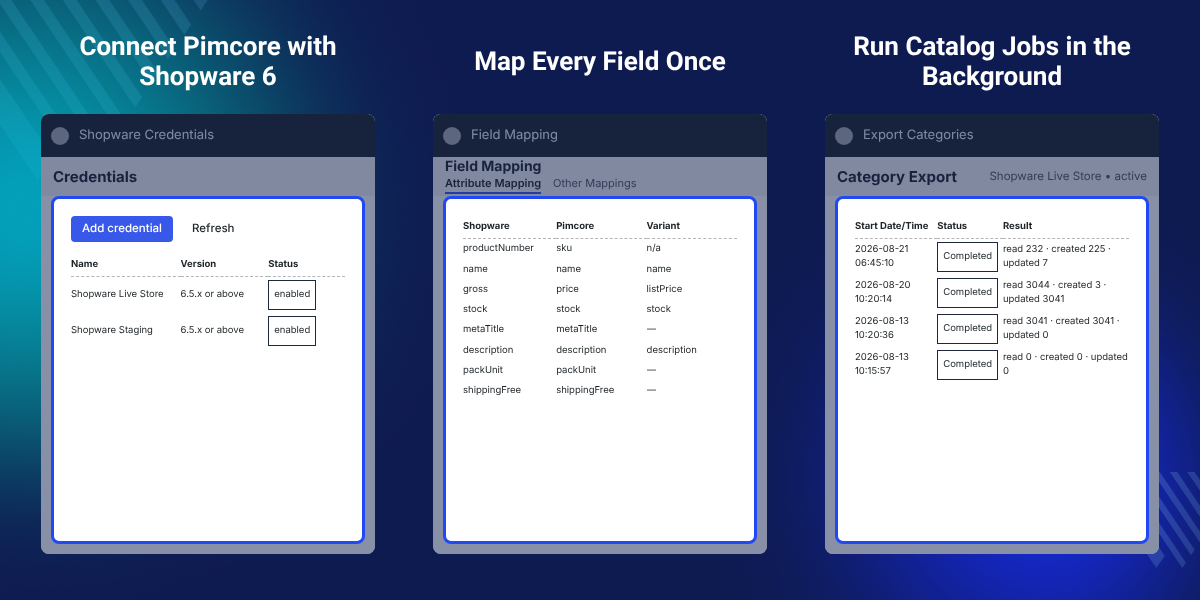
    Admins set the field mapping in the user interface, not in code. They pair each Shopware field with a Pimcore field once, and both directions then use that same map.

    Additionally, if you want to translate a Pimcore catalog before you send it to a store, then check Pimcore DeepL Translation Connector.
    Pimcore Shopware 6 Connector

    Highlighted Features of Pimcore Shopware 6 Connector

     Two-Way Catalog Sync

    Send categories, products, and attributes to Shopware 6, and pull customer and order records back into Pimcore.

     Shopware Admin API Transport

    The connector reads data through the Shopware search endpoint and writes it through the Sync API in batches to handle large data runs efficiently.

     Dynamic Field Mapping

    Map each Shopware field to a Pimcore field from the screen. One saved map drives both import and export.

     Variant Product Support

    Export a parent product with its property groups, then each child variant with its own number and images.

     Background Job Engine

    Jobs run through the Symfony Messenger queue, so a long catalog run never blocks the Pimcore screen.

     Duplicate-Free Re-Runs

    Each record carries a fixed Shopware id built from its Pimcore id, so a repeat run updates the same row.

     Image and Media Sync

    Pimcore assets upload as Shopware media, and Shopware images download into the Pimcore asset tree.

     Fine-Grained Permissions

    Separate rights cover credentials, mapping, export, import, and job control for each admin role.

    Why Do We Need Pimcore Shopware 6 Connector?

    Pimcore stores clean product records, while Shopware 6 handles sales, requiring teams to manually transfer catalog data between systems.

    Manual transfers require CSV exports, column checks, and fresh uploads for price changes, while variants and images create additional complexity. This connector simplifies PIM to Shopware sync by creating jobs that map fields, select entities, and transfer records automatically.

    Each product export uses the Pimcore object ID as its Shopware ID, allowing repeated exports to update existing products.

    The same process removes Shopware media missing from Pimcore and skips products without exported images during each synchronization run.

    Also, if you want to send the same Pimcore catalog to an ERP system, you can check our extension Pimcore Odoo Connector.

    Use Cases

    Shopware 6 catalog sync suits teams that keep one clean product record and sell it in more than one place. If a second storefront runs on Shopify, pair this bundle with Pimcore Connector for Shopify.

    • Move a Catalog to Shopware

      A brand that already keeps its catalog in Pimcore can push categories, attributes, and products into a new Shopware 6 store.

    • One PIM, Many Storefronts

      Each Shopware store gets its own credential record. A team runs the same export against any store it has enabled.

    • Keep Variant Data Correct

      Fashion and furniture sellers hold colour and size values in Pimcore, and the export rebuilds the same option set in Shopware.

    • Pull Shopware Data Into Pimcore

      A store that grew inside Shopware can import its live categories, products, and attributes to start product information management in Pimcore.

    Shopware Credentials in Pimcore

    The Credentials screen lists every Shopware store the connector can reach. Each row is one saved store, and a team keeps as many rows as it has environments.
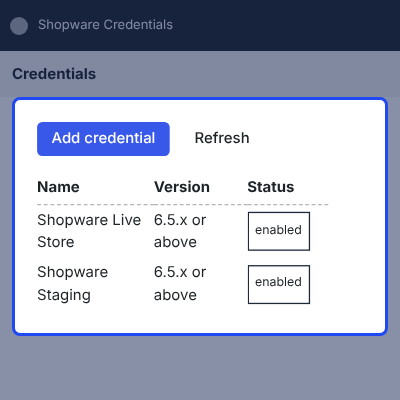
    • Add a store from the Credentials screen, then keep one row per Shopware environment.
    • Read the Name, Version, Test, Status, and Actions columns for every saved store.
    • Run Test connection on a row to check the host and the keys before a job starts.
    • Turn a store off with the enabled switch; a disabled row drops out of the job picker.
    • Mark one row as active, and edit or delete any other row.
    Shopware Credentials in Pimcore

    Add a Shopware Integration Credential

    Add credential opens a two-part form. Connection holds the store details, and API integration holds the key pair that Shopware issues.

    The form names the exact route to follow inside Shopware, so nobody has to hunt for it.
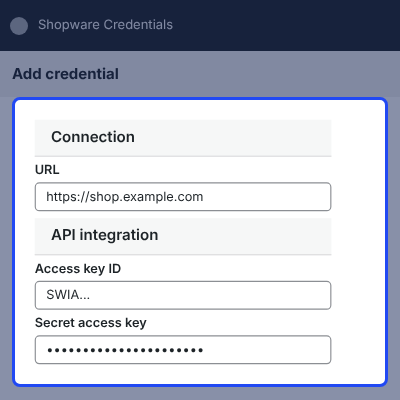
    • Enter a Name and the store URL, such as https://shop.example.com.
    • Pick the Shopware Version, which reads 6.5.x or above.
    • Follow the on-screen route: Shopware admin > Settings > System > Integrations.
    • Paste the Access Key ID, which starts with SWIA, and the Secret Access Key.
    • Save the row, then run Test connection against it from the Credentials list.
    Add a Shopware Integration Credential

    Shopware to Pimcore Field Mapping

    Field Mapping pairs each Shopware field with a Pimcore field in one table. A third column gives variants their own target, so a child can differ from its parent.
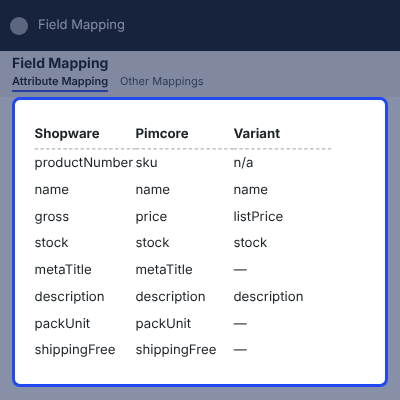
    • Work in the Attribute Mapping tab, with Other Mappings beside it.
    • Read three columns: Fields in Shopware, Fields in Pimcore, and Variant Fields in Pimcore.
    • Keep productNumber paired with sku at the head, where the variant column reads n/a.
    • Pair gross with price, and give each variant its own listPrice.
    • Map stock, description, metaTitle, packUnit, and shippingFree in the same table.
    Shopware to Pimcore Field Mapping

    Cover, Gallery and Variant Image Mapping

    The Other Mappings tab drives media sync by keeping the image roles apart. Cover, parent gallery, and variant gallery each read from their own Pimcore attribute, so one never overwrites another.
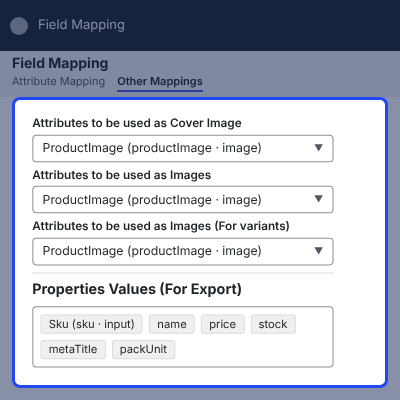
    • Set Attributes to be used as Cover Image on its own picker.
    • Set Attributes to be used as Images for the parent gallery.
    • Set Attributes to be used as Images (For variants) for the child galleries.
    • Pick ProductImage (productImage · image) for any of the three roles.
    • Choose the Properties Values (For Export) set, with SELECT ALL and DESELECT ALL.
    Cover, Gallery and Variant Image Mapping

    Export Products with Currency and Locale

    Product Export writes Pimcore products to Shopware. Three selectors sit above the run button, so a team can narrow a run instead of pushing the whole catalog every time.
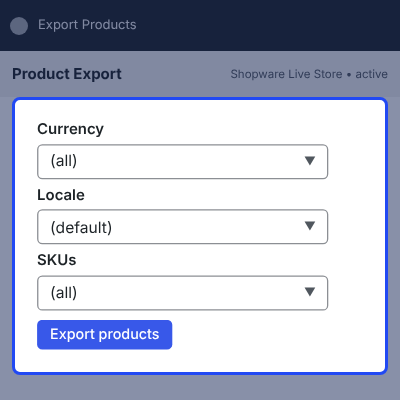
    • Pick the target store from the credential list at the top of the screen.
    • Set Currency to limit the extra currency rows a run writes.
    • Set Locale to choose the language written beside the base language.
    • Set SKUs to export a named list instead of the whole catalog.
    • Leave a selector on its default to export every mapped value.
    • Press Export products to queue the run in the background.
    Export Products with Currency and Locale

    Job Runs and Result Counts

    Each Export and Import screen carries its own run list. A row records who started the run, which store it wrote to, how it ended, and how many records it touched.
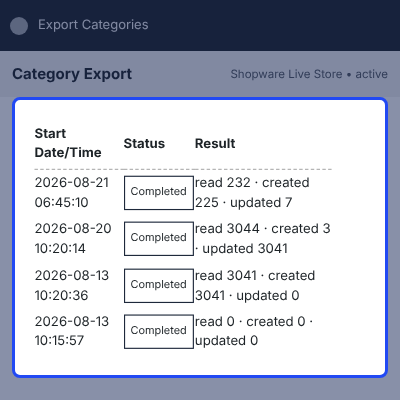
    • Read Start Date/Time and User for every run on that screen.
    • Read the Credential column to see which store a run wrote to.
    • Read the Status column, which shows Completed, Stopped, or Failed.
    • Read the Result column, which counts records read, created, and updated.
    • Open a row to follow a running job while it is still working.
    Job Runs and Result Counts

    Shopware Options Import

    Options Import fetches the reference lists a Shopware product needs before it is exported again. Re-running refreshes each list in place, so nothing is duplicated.
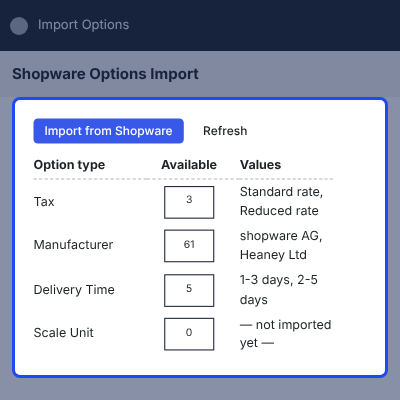
    • Press Import from Shopware to pull the lists, then Refresh to reload the table.
    • Read Option type, Available, and Values for each list.
    • Load Tax, and read its rates, such as Standard rate and Reduced rate.
    • Load Manufacturer, Delivery Time, Scale Unit, and Sales Channel in the same run.
    • See a count against each list, and a not-imported note for one never fetched.
    Shopware Options Import

     Support

    For any query or issue please create a support ticket here http://webkul.uvdesk.com/

    You may also check our other top-quality Shopware Modules.

    Specifications

    Product Version1.0.0
    Released6 years ago
    Last UpdatedSeptember 1, 2026 (4 days ago)
    Supported VersionsPimcore  2026.x  12.x  6.1.0  Shopware  

    Ratings

    We'd love to hear your thoughts! Share your feedback and help us craft an even better experience tailored just for you.

    Write a review

    Frequently Asked Questions

     How does Pimcore Shopware 6 Connector work?

    Pimcore Shopware 6 Connector adds import and export screens inside Pimcore Studio. An admin saves a Shopware credential, maps the fields, picks an entity, and starts a job that reads the records and writes them to the other system.

     
     Which Shopware API does the connector use?

    It uses the Shopware 6 Admin API. Reads go through the search endpoint, and writes go through the Sync API in batches. The connector authorises the connection with OAuth2 client credentials from a Shopware integration.

     
     Does the connector sync data in both directions?

    Yes, Categories, products, variant products, and attributes move in both directions. The import also brings Shopware customer records and orders into Pimcore.

     
     Will running the same job twice create duplicate products?

    No, each exported record carries a fixed Shopware ID built from its entity type and Pimcore id. The writer also matches a record on its business key before it creates one, so a second run updates the same row.

     
     Can the connector export configurable products with variants?

    Yes, the export writes the parent product with its variant-defining property groups and options, then each child variant with its own product number, option values, and images.

     
     Does the connector need any other Webkul bundle?

    No, The job engine and the helper services ship inside the bundle, so it installs on its own. It runs on Pimcore 2026.x.

     
     What happens if a job is stopped in the middle of a run?

    The job checks a stop flag and ends after the current step. Records that already reached Shopware stay in place, and the run shows as Stopped in that screen's run list.

     
     Can I limit an export to certain SKUs, a currency, or a language?

    Yes, the product export screen carries Currency, Locale, and SKU selectors, and the command line takes the same three options. The store default currency and base language always go out.

     
     Does the connector sync automatically on a schedule?

    Not yet. Admins start each run on demand from the Pimcore Studio screens or from the console commands, and the queue then processes it in the background.

    Specification

    Detailed technical features and requirements to help you understand the module’s capabilities and ensure smooth integration with your system.

    Cloud Hosting

    Detailed technical features and requirements to help you understand the module’s capabilities and ensure smooth integration with your system.

    Default Configuration Details of Server

    1 GB
    RAM
    1 Core
    Processor
    30 GB
    Hard Disk
    1 GB RAM & 1 Core Processor
    Database

    Want to know more how exactly we are going to power up your eCommerce Website with Cloud to fasten up your store

    * Server Configuration may vary as per application requirements.

    Change Logs

    • - Feature Add (+)
    • - Feature remove (-)
    • - Bug Fixed (!)
    • - Modification (*)
    Version 1.0

    Added

    • Pimcore Studio plugin with Credentials, Object Mapping, Export, Import, and Job History screens.
    • Two way import and export for categories, products, attributes, and variant products.
    • Shopware Admin API transport with OAuth2 client credentials authentication and Sync API support.
    • Fully dynamic Object Mapping for Shopware entities and Pimcore classes.
    • Image and media synchronization between Pimcore and Shopware.
    • Deterministic ID mapping for stable Shopware records and idempotent re runs.
    • Background export and import jobs with live progress, step counts, and Stop control.
    • Console commands for export, import, credential testing, and demo data creation.
    • One command installer and uninstaller for connector classes, tables, mappings, and permissions.
    • Product export scoping with Currency, Locale, and SKU selectors.
    • Credential settings for Default Store Currency, Default Language, store selection, and enable or disable control.
    • Shopware Options Import for Tax, Manufacturer, Delivery Time, Scale Unit, and Sales Channel.
    • Independent product image mappings for cover, parent gallery, and variant gallery.
    • Gallery mirroring to remove Shopware images that are deleted or replaced in Pimcore.
    • Streamlined Studio screens with reorganized field mapping and credential management.
    • Reliable variant round trip that updates existing variant children instead of creating duplicates.
    • Object Mapping permission validation to prevent unauthorized Pimcore class changes.
    • Installer file ownership handling for the var/ and public/var/ directories.

    Notes

    • The connector bundle is self contained and does not require separate CoreBundle registration.
    • Supports Pimcore 2026.x and PHP 8.4+ with a Shopware 6 instance and enabled Admin API integration.
    • The installer creates lean connector classes that can be extended in Pimcore Studio.
    • Run shopware:install before opening the connector screens.

    • Refer to README.md for complete installation and setup instructions.